



Horn Low Register: Don't Loosen or Push Forward. Use the Lower Jaw to Shape the Oral Cavity for Connected Tone
When you can't produce low notes, forcing them out by loosening the lips, pushing them forward, or puffing out the cheeks creates an embouchure that won't connect to the upper register. For low notes, shape the oral cavity by moving the lower jaw, without loosening or pushing the lips forward. Start by forming a generous "lower embouchure" that reliably produces sound, ascend from pedal tones by half steps, find the range where it overlaps with the upper embouchure, and establish a switching point.
![[Saxophone] A Musical Approach to Dynamic Markings: Q&A on Playing Forte and Piano with Expression](https://i.vimeocdn.com/video/1845680316-3f38669063d88bea54c494d009f63bac20dc9397ffc248af3519720f24507baf-d_1280x720?&r=pad®ion=us)
[Saxophone] A Musical Approach to Dynamic Markings: Q&A on Playing Forte and Piano with Expression
Interpreting dynamic markings musically on the saxophone is a crucial element in enhancing your expressiveness. The forte and piano markings written in a score should not be seen as mere indicators of loud and soft volume, but rather as symbols that express the mood and emotion of a phrase. For example, even within piano, there are many different images: a gentle piano, a quiet piano, a sorrowful piano, and more. Likewise, within forte, there are various expressions possible: a powerful forte, an expansive forte, an energetic forte, and so on. This article provides a detailed Q&A-format explanation of how to interpret dynamic markings musically and how to create a variety of tonal expressions using air speed, oral cavity space, and subtle pitch adjustments.

Complete Guide to Saxophone Half-Tonguing: How to Improve Effectively with Register-Specific and Scale Exercises
Half-tonguing on the saxophone is an advanced technique that articulates the sound by lightly touching the tongue to the reed. Because the tongue position and pressure change depending on the register, it is essential to practice individually in the low, middle, and high registers. By incorporating scale-based timing exercises, you can reliably develop practical technique.
![[Clarinet] Mastering the Register Key: Essential Techniques and Practice Methods for Expanding Your Range](https://i.vimeocdn.com/video/1845658581-b552d0f477bf85bac1681b3c091f57560678ea091e6887c7d4095d64ae9d5468-d_1280x720?&r=pad®ion=us)
[Clarinet] Mastering the Register Key: Essential Techniques and Practice Methods for Expanding Your Range
The clarinet's register key is an essential key that uses overtones to produce notes a twelfth above by pressing the elongated key. Similar to how a recorder uses the thumb to produce notes an octave higher, the register key serves the same role on the clarinet. For example, if you play a C and press the register key, a high G will sound. This article provides a detailed Q&A guide covering the basic mechanism of the register key, proper finger placement and standby positioning, causes and solutions for disconnected notes, and effective practice methods.

Clarinet Long Tones: A Fundamental Exercise for Refining Articulation, Breathing, and Release
Long tones may seem tedious, but they let you check your clarinet articulation, tonguing, and breath control all at once. This article covers a method of ascending chromatically with 4 beats of preparation, 8 beats of sustain, and 4 beats of rest, along with key checkpoints to keep in mind.

Horn Warm-Up 5: Find a Steady Tone Through Long Tones and Adapt Your Routine Flexibly
Warm-Up 5 is about building on your personal best routine and adapting flexibly to the day's condition and performance demands. If you add anything, make it long tones. Progress from non-attack entry to mid-note tonguing to attack-from-the-start tonguing, confirming a steady, wobble-free approach. Think of the warm-up as stretching and fundamentals practice as weight training. This distinction keeps you from jumping straight into heavy lifting.
![[Trumpet] Mastering Articulation and Release: Syllable Techniques and Natural Decay Inspired by Bowling](https://i.vimeocdn.com/video/1872856048-58a0d1a280a7214d4c7c220f41dbb6fae4d95319b1c20c0ace810bb2c660b9ed-d_1280x720?&r=pad®ion=us)
[Trumpet] Mastering Articulation and Release: Syllable Techniques and Natural Decay Inspired by Bowling
Simply paying careful attention to how you start and end each note on the trumpet can dramatically transform your performance. From no-tonguing exercises that begin with breath alone, to mastering three syllables—Tu, Ta, and Lu—and embracing a release technique inspired by bowling where you "let go and trust the resonance," this article compiles practical exercises and key points to keep in mind.

Trumpet Staccato Technique: Polishing Your Sound with a "Completion" Mindset - Q&A
In trumpet staccato playing, the awareness of "completing" each note is more important than simply making it short. By completing each note without stopping the airflow and creating appropriate gaps between notes, you can achieve clear, musical staccato. This article provides a detailed Q&A-style guide covering the fundamentals of staccato, how to develop a completion mindset, airflow control, and how to create gaps between notes.
Breath Training for Trumpet: Unlocking Your Potential with the 8-Beat Breathing Exercise
In trumpet breath training, it is essential to always take a full, deep breath close to maximum capacity regardless of dynamics. By performing the 8-beat breathing exercise at tempo 60 — "inhale for 8 beats, hold for 8 beats, exhale for 8 beats, hold for 8 beats" — with full effort, you can unlock the trumpet's true potential.

Piccolo Training Method: Refining Your Tone and Developing Stable Control Across All Registers
Simply transferring your flute practice routine to the piccolo is not enough to master this instrument. You need a dedicated piccolo training regimen optimized for its smaller body and faster response. This method presents concrete exercises covering long tones, scales, and interval leaps to help you achieve a uniform tone and accurate pitch across all registers. A focused, step-by-step practice routine designed to make the piccolo one of your strongest instruments.
![[Saxophone] Proper Soprano Saxophone Posture: Reducing Physical Strain and Stabilizing Your Tone](https://i.vimeocdn.com/video/1845670820-965a059753d3031688349376091add84e065789df99bb6336949e197ab9a86f4-d_1280x720?&r=pad®ion=us)
[Saxophone] Proper Soprano Saxophone Posture: Reducing Physical Strain and Stabilizing Your Tone
The way you hold a soprano saxophone can dramatically change how it feels to play. From the differences between straight and curved necks, to the role of the right hand in supporting the instrument, to self-checking your form with a mirror, we reveal the secrets to building a natural, beautiful posture with minimal strain.
![[Saxophone] The Depths of Embouchure: Mouth Shape and Tongue Position for Creating Your Ideal Sound](https://i.vimeocdn.com/video/1845664832-c8db2e92103cdf47aa8494c28de3f3c894c179d847219df0422a271507ed224b-d_1280x720?&r=pad®ion=us)
[Saxophone] The Depths of Embouchure: Mouth Shape and Tongue Position for Creating Your Ideal Sound
The key to a beautiful tone lies in what you cannot see: the inside of your mouth. From how much you curl your lower lip, to tongue elevation, to opening the throat, this lesson provides a detailed look at the inner workings of a professional embouchure.

Mastering Lip Slurs on Trombone: Efficient Practice Methods and Checkpoints
Once you understand the mechanics of lip slurs, it's time for hands-on training. This lesson explains the specific steps for connecting notes smoothly and how to avoid common mistakes. Review this checklist to develop smooth control across all registers without sacrificing the rich overtones unique to the trombone.
![[Saxophone] Mastering Baritone Saxophone Articulation: Achieving Ideal Tonguing Through the Balance of Tongue and Air](https://i.vimeocdn.com/video/1845681205-45edcf49b886c22c84cfa21028ab0a1b7c03330be5c5bb3ccb3ae1377435f74d-d_1280x720?&r=pad®ion=us)
[Saxophone] Mastering Baritone Saxophone Articulation: Achieving Ideal Tonguing Through the Balance of Tongue and Air
For **saxophone**, especially baritone saxophone, articulation hinges on tongue technique and breath control. This article provides a detailed Q&A-style guide on practical methods for minimizing the contact area with the reed and avoiding slap tonguing.

Mastering Tuba Etudes: A "Dialogue-Based" Practice Method for Reading the Composer's Intent
Are you letting your tuba etude practice end as mere finger exercises? This guide offers a professional approach to mastering etudes by understanding the musical messages embedded by the composer and systematically overcoming technical challenges through a logical Q&A format.
![[Saxophone] The Core of Mastering Altissimo: Refining Your 'Overtone Awareness' Beyond Fingerings](https://i.vimeocdn.com/video/1845667154-a0833303f98c3cb043fd5ace024d4915547d93bbc2f4b5091c37c2a28a08fb25-d_1280x720?&r=pad®ion=us)
[Saxophone] The Core of Mastering Altissimo: Refining Your 'Overtone Awareness' Beyond Fingerings
Altissimo (the extreme upper register) expands the expressive range of the saxophone. What matters even more than fingerings is the direction of your airstream and the shape of your oral cavity. Through overtone exercises, develop the physical awareness to hit your target notes with pinpoint accuracy.

Choosing the Right Strap for Comfortable Bassoon Playing: Reducing Physical Strain and Unlocking Expressive Freedom
The bassoon is a heavy instrument, and choosing the right strap directly impacts both playing comfort and technical development. This article provides a thorough comparison of various strap types, focusing on the popular Breathtaking strap, as well as shoulder-type and seat straps, examining their respective advantages and disadvantages. We offer tips for selecting the optimal strap based on each player's physique and playing style, considering factors such as neck strain, torso flexibility, and range of motion.
![[Trumpet] Overcoming Fatigue During Performance: Form Design and Recovery Steps for Building Endurance](https://i.vimeocdn.com/video/1872858049-26e5503951facaee56c2bf7001b627103429fb36a6b7ea6096d87c9afdc21103-d_1280x720?&r=pad®ion=us)
[Trumpet] Overcoming Fatigue During Performance: Form Design and Recovery Steps for Building Endurance
Whether you are just starting out on the trumpet or have been playing for years, many players have experienced the frustration of their lips giving out and losing their sound by the end of a piece. To prevent fatigue, it is important to combine endurance training during fundamental practice, bamboo skewer exercises to strengthen embouchure support, and proper hydration and lip moisturizing. This article provides step-by-step guidance on understanding the causes of fatigue, building a fatigue-resistant playing technique, recovering when fatigued, and establishing a routine for refining your tone.
![[Oboe] Mastering Alternative Fingerings: Choosing E, E-flat, and F Fingerings and Improving Fork F Tone Quality](https://i.vimeocdn.com/video/1845715518-31e35ad4063168b0609d525fccb85ae8a65a624d7d13dfd24e978053b61bda71-d_1280x720?&r=pad®ion=us)
[Oboe] Mastering Alternative Fingerings: Choosing E, E-flat, and F Fingerings and Improving Fork F Tone Quality
The oboe has multiple fingerings for producing the same note, and the optimal choice depends on the surrounding notes. E and E-flat have two fingering options, while F has three, and Fork F in particular requires practice to match the tone quality of the standard fingering. This article provides a detailed guide to selecting the right oboe fingerings, improving Fork F tone quality, and mastering finger-switching techniques.
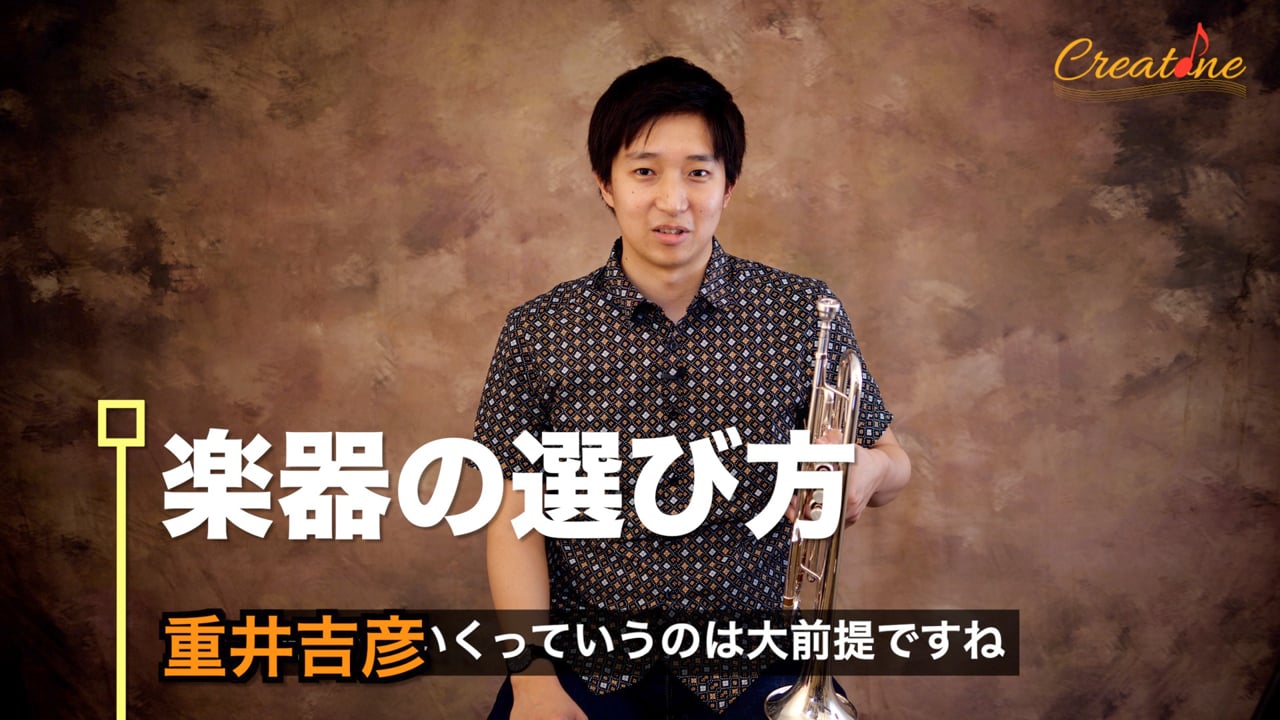
How to Choose a Trumpet: Lesson 1 — Key Points for Selecting Your Instrument
When choosing a trumpet, it is important to go beyond appearances and actually play-test the instrument. By comprehensively evaluating multiple factors — including craftsmanship and setup, intonation accuracy, ease of slurring, and responsiveness — you can find the trumpet that is right for you.
