



How to Choose a Horn Mouthpiece: Finding the Optimal Match Based on Rim, Inner Diameter, Cup, and Throat Size
Choosing a horn mouthpiece is not simply a matter of tonal preference—it requires a comprehensive evaluation of multiple factors, including rim shape, inner diameter size, cup shape, and throat size. By selecting a mouthpiece that compensates for your weaknesses, you can improve playability and get closer to your ideal tone. This guide explains key points and practical selection methods for choosing a horn mouthpiece, comparing common mistakes with recommended approaches.
![[Horn] Mastering F Horn Practice: Accelerate Your Progress by Controlling the Difficulty](https://i.vimeocdn.com/video/1873116891-e10302bf2bbf7ce6a1a9b82c7e1e89c0013f46f83c62f7c9fdb41a382a7a1b77-d_1280x720?&r=pad®ion=us)
[Horn] Mastering F Horn Practice: Accelerate Your Progress by Controlling the Difficulty
In horn playing, practicing on the F horn is key to technical improvement. While the F horn can feel more difficult to play compared to other sides of the instrument, this difficulty serves as an indicator for detecting misalignments in your air, embouchure, and posture. By continuing to practice on the F horn, your embouchure flexibility increases, making it easier to handle various registers and dynamics. This lesson organizes the approach to F horn practice and how to structure your sessions for sustainable progress.

Steps to Refine Your Bassoon Tone
Refining your bassoon tone requires attention to how you direct your airstream, including its angle and speed. By clearly distinguishing between marcato accents, staccato, and regular accents, you can achieve more expressive and nuanced performances.

Improving Precision in Percussion Performance: Mastering Double Grace Notes
A detailed guide to the double-stroke technique for playing double grace notes. Refine your skills from a professional perspective, covering fine adjustments to striking position and directing momentum toward the main note.
![[Saxophone] Overcoming Cross-Fingering: From Concept to Practice, Alternate Fingering Techniques for Smooth Execution](https://i.vimeocdn.com/video/1845702099-5223fe806f560373ac0f01f3b3709137eef38a8385f829942ceb3f680367adde-d_1280x720?&r=pad®ion=us)
[Saxophone] Overcoming Cross-Fingering: From Concept to Practice, Alternate Fingering Techniques for Smooth Execution
In saxophone playing, cross-fingering is a problem that hinders smooth finger movement. By understanding common cross-fingerings such as B to C and F to F-sharp, and learning to use alternate fingerings like the TC key, TF key, and TA key, you can achieve smooth performance of chromatic passages and trills. This article begins with the concept of cross-fingering, then explains how to resolve it using alternate fingerings and put them into practice, providing a comprehensive guide to improving fingering technique in saxophone playing.

Horn Long Tones: A Two-Step Approach Starting with No-Attack Entry and Then Checking Your Tonguing
Long tones tend to become a mindless exercise of simply sustaining notes, but practicing without intention is not only painful but also less effective. The Hamaji method uses a two-step approach: first entering with a no-attack breath onset, then checking your tonguing within the airflow on the second pass. This article breaks down a system designed to eliminate anxiety about note entries and help you find the optimal balance for articulation.
![[Clarinet] Mastering Fast Passages: Rhythm Pattern Drills and Breaking Down Trouble Spots](https://i.vimeocdn.com/video/1845657769-6804b301fbd0d6687ddaaebb022d3cd08c5dbbc6e51c46dab1ee9eb092c28cf4-d_1280x720?&r=pad®ion=us)
[Clarinet] Mastering Fast Passages: Rhythm Pattern Drills and Breaking Down Trouble Spots
To stabilize fast runs and rapid-note passages on the **clarinet**, you need more than sheer willpower — you need to rewire your brain through rhythm-pattern training. This guide walks you through four fundamental patterns and a concrete step-by-step method for isolating and conquering weak two-note connections, all the way up to smooth trills.
![[Trombone] Instrument Warm-Up for Performance: Glissando Through the Harmonic Series and Valve Technique](https://i.vimeocdn.com/video/1872842804-cfa1daa23c480d8f4d8e080aff056b4248f5c7b8d89a23e58d80b9a8e4cfedd5-d_1280x720?&r=pad®ion=us)
[Trombone] Instrument Warm-Up for Performance: Glissando Through the Harmonic Series and Valve Technique
It's time to connect the vibration you've refined on the mouthpiece to the full resonance of the instrument. From air-attack exercises starting on Bb above the staff to pitch checks on each position of the F and Gb attachments, we break down the systematic instrument warm-up practiced by professionals.

Feeling 6/8 Time on Clarinet: Learning Rhythm and Expression Through Rose 32 Etudes No. 7
In clarinet performance, 6/8 time is one of the meters that many players find challenging. Rose 32 Etudes No. 7 is an etude designed to practice 6/8 time, written in A minor for clarinet (concert pitch D minor), with a modulation to F major partway through, creating a piece rich in tonal color. By understanding the concept of a meter that divides two beats into three subdivisions each, and by maintaining the imagery of a Siciliana, you can learn how to prevent fast notes from sounding rushed in a relaxed piece.
![[Euphonium] Expressing Dynamics Musically: A Q&A on Understanding the Meaning Behind Dynamic Markings](https://i.vimeocdn.com/video/1845691527-849951b342e6975a19600a4b731e2337dbd4237e2b192226687532172bdd4454-d_1280x720?&r=pad®ion=us)
[Euphonium] Expressing Dynamics Musically: A Q&A on Understanding the Meaning Behind Dynamic Markings
Dynamics on the euphonium are not simply about playing loud or soft. Markings like forte and piano each carry musical meaning and emotion. Words like "strong" and "weak" cause physical tension in the body, so replacing them with alternative expressions enables more musical playing. Adding enriching associations — such as "richness," "triumphant joy," or "spatial expansion" for forte, and "delicacy," "lingering sentiment," or "focus" for piano — enhances the music. This article uses a Q&A format to explain the essential meaning of dynamics and how replacing words can elevate your expressive ability.

How to Use Your Thumbs on Saxophone: Achieving Stable Playing Through Correct Positioning and Support
In saxophone playing, thumb positioning and technique are extremely important elements for stabilizing the instrument. The saxophone is fundamentally supported at three points: the neck strap, the ring connecting your neck to the instrument, and your upper teeth. However, these three points alone are not enough to keep the instrument stable, which is why the left and right thumbs play a crucial role. The left thumb firmly presses against the thumb rest to support the instrument and is also responsible for operating the octave key and table keys. This lesson explains specific practice steps for mastering saxophone thumb technique by comparing incorrect and correct examples.

Euphonium Phrasing: How to Enhance Expressiveness by Setting a Destination
Euphonium phrasing changes dramatically when you decide "where the destination is" rather than being driven by pitch. Applying the concept of dividing words into syllables, this lesson organizes practice methods for clarifying phrase boundaries and arrival points.
![[Saxophone] How to Improve Your Expressiveness by Mastering Two Types of Staccato](https://i.vimeocdn.com/video/1845660576-f66c21ebf1db67dc2b0b9def8de9363ce1410784088e9c30a4ee4f65527963cb-d_1280x720?&r=pad®ion=us)
[Saxophone] How to Improve Your Expressiveness by Mastering Two Types of Staccato
There are broadly two types of staccato technique for the saxophone: a staccato that completely cuts the sound using the tongue, and a staccato that leaves a resonant tail using abdominal support. Many saxophone players tend to only use the latter type that leaves a resonant tail, but for consecutive staccato passages and fast-tempo playing, the former crisp staccato is indispensable. By properly using both types of staccato, you can significantly enhance your saxophone expressiveness.

Fast Tonguing on Horn: Minimizing Tongue Movement to Achieve Both Speed and Accuracy
To master fast passages on the horn, you need to make your tongue movement as compact as possible. In Hamachi-style Training 8, we thoroughly pursue "tongue efficiency" to break through the limits of single tonguing. This lesson explains in detail the body mechanics for eliminating unnecessary movement and maintaining precise rhythmic articulation, along with the foundational concepts that lead to double tonguing.

Conquering Difficult Bassoon Passages: Rhythm and Accent Variation Training
Simply repeating a fast phrase over and over is not enough when you cannot play it. This article explains in detail rhythm variation exercises (dotted-note patterns and their inversions) and accent-shifting practice designed to help bassoonists conquer difficult passages. Develop a philosophy that transforms technique into confidence.

Saxophone: How to Select and Break In Reeds — Managing the Consumable That Defines Your Tone
Reed selection is the eternal challenge for every saxophonist. This article covers how to break in reeds through rotation, how to recognize when a reed has reached the end of its life, and management techniques to keep your sound consistent.

The Foundation of Oboe Playing: Breathing Exercises to Activate Your Lungs
A rich tone and stable breath control are essential in oboe playing. This article provides a detailed guide to breathing exercises that maximize lung function while focusing on the oboe embouchure.
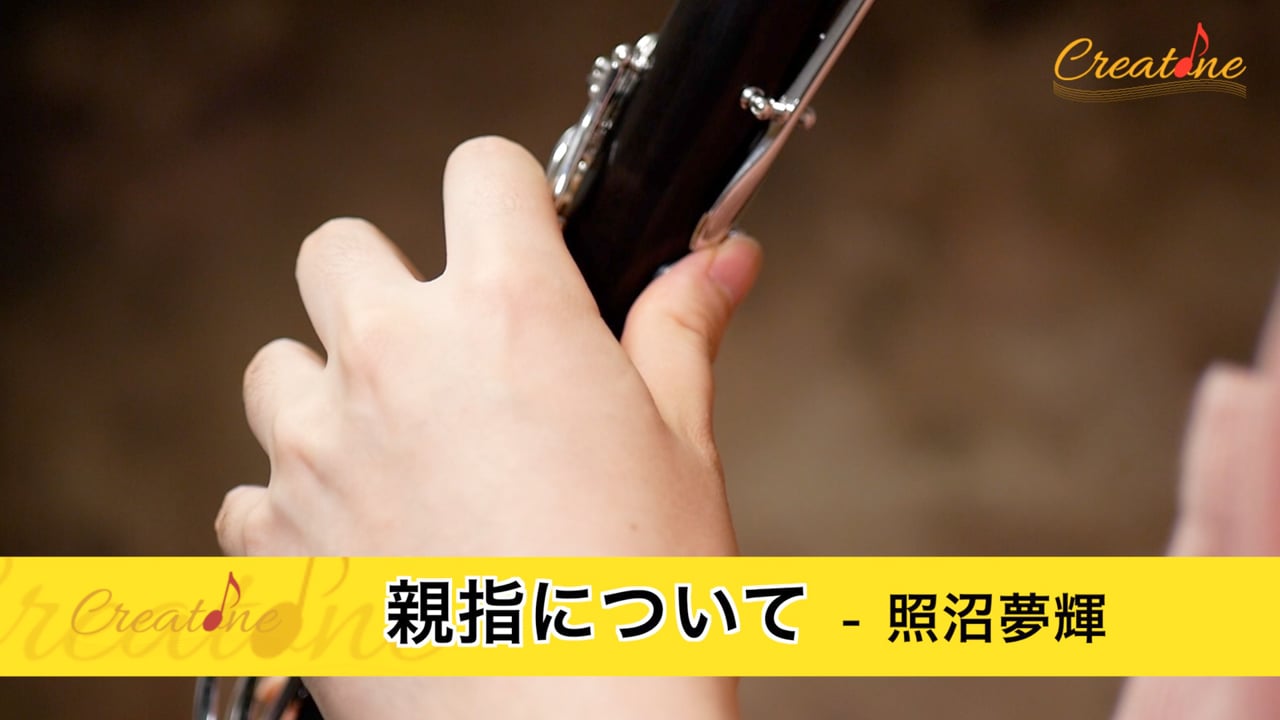
Thumb Position and Shape for Clarinet: How to Operate the Register Key Efficiently
In clarinet playing, the position and shape of the thumb that operates the register key greatly affects the ease of finger movement and playing stability. If you press the thumb straight against the key, it becomes difficult to create the ideal finger shape, making it harder to operate the A and G keys. This article provides a detailed explanation of the correct thumb position and shape, as well as efficient techniques for operating the register key.
![[Bassoon] Anacrusis and Dynamic Control: Mastering Musical Expression Q&A](https://i.vimeocdn.com/video/1845677107-4ac7933874e2f4cffd28fbf4b0fd869d5fa6d9b070daa5c96cb8ec6c294df38b-d_1280x720?&r=pad®ion=us)
[Bassoon] Anacrusis and Dynamic Control: Mastering Musical Expression Q&A
When playing pieces that begin with an anacrusis on the bassoon, it is important to feel as though you are lifting your center of gravity upward and flowing into the next beat. Because double reeds can make articulation unpredictable, starting the first note too forcefully will leave listeners unable to discern the meter or beat placement. Before playing an anacrusis, always feel beats 1 and 2 internally, and begin producing sound within that upward motion. This article provides a detailed Q&A covering anacrusis performance technique, forte and piano dynamic control, legato connections, fermata handling, and the expression of ritardando and diminuendo.

Trumpet Care: The Basics of Daily Maintenance to Preserve Your Sound
Trumpet care is essential for preserving resonance and maintaining sound quality. This article provides a detailed, frequency-based guide to trumpet maintenance, from daily basics like valve oil and swabs to periodic checkpoints such as tuning slide grease, piston felts, water key corks, and springs. By mastering proper care techniques, you can maximize your trumpet's performance.
