


![[Oboe] Ideal Posture and Finger Shape: The Foundations for Producing a Beautiful Tone](https://i.vimeocdn.com/video/1845715061-49dd3e06c9fd7da31a7e82eba10f44efefb94bca4ed0cccf11b52cdc560c8c15-d_1280x720?&r=pad®ion=us)
[Oboe] Ideal Posture and Finger Shape: The Foundations for Producing a Beautiful Tone
When playing the oboe, your posture and finger shape are critical elements that directly affect your tone quality. By bringing the instrument closer to your body, maintaining a relaxed position, and curving your fingers as if wrapping around your airstream, you can enrich your sound. This article provides a detailed guide to achieving the ideal oboe posture and the key points for securely covering the tone holes with your fingertips.

Smoothing Your Bassoon Fingering: Ideal Finger Positioning and How to Fix "Slapping Fingers"
The bassoon is a large instrument where finger positioning directly impacts the quality of your playing. This lesson provides a detailed explanation of the common "slapping fingers" problem and the arched finger shape that solves it. Learn specific practice routines and setup adjustments for smoother operation of the left-hand S key, cheese key, and complex thumb keys, and take your technique to the next level.

Horn Warm-Up Part 2: Don't Try to "Produce" 2-3 Octaves with Light Air
The purpose of a warm-up is not to produce a good tone on the horn, but to check how easily your lips vibrate, how your oral cavity shape affects your range, and to wake up your body. Play a 2-octave scale with light air, moving up by half steps, and extend to 3 octaves if you have the capacity. On bad days, dropping to 1 octave is perfectly fine. Here we outline how to design your warm-up as something entirely separate from your main practice.

Mastering Bassoon Embouchure: Practice Steps for Optimizing Reed Position and Lip Shape
In bassoon performance, embouchure is a crucial element that determines tone quality and control. Biting the reed too deeply stops its vibration, while placing it too shallowly causes misfires. This lesson explains specific practice steps for mastering bassoon embouchure, comparing incorrect and correct examples.

Mastering Flute Volume Control! How to Create Resonance That Solves the "Can't Be Heard" Problem
Have you ever been told your flute solo "can't be heard"? This article provides practical solutions for projecting your sound without relying on sheer volume, including how to target the "sweet spot," how to balance with surrounding instruments, and more.

Supercharge Your Fundamentals with Saxophone Scale Practice! A Comprehensive Training Method Covering Two and a Half Octaves
Saxophone scale practice is not merely a finger exercise—it is a comprehensive fundamental training method that encompasses long tones, tonguing, and finger passage work. Since the saxophone offers a range of approximately two and a half octaves, it is important to practice scales using the full range. By carefully checking each note, delivering a steady airstream into the instrument, and maintaining a consistent embouchure and air direction, you can achieve tonal uniformity. Additionally, incorporating arpeggios further enhances embouchure control.
![[Saxophone] How Vibrato Works and How to Use It: Enhancing Expressiveness Through Pitch Control](https://i.vimeocdn.com/video/1845660779-a9874a54515f185cfb16b9eab48c2fa62120fe68514cb7db8d1a59b7e324ad35-d_1280x720?&r=pad®ion=us)
[Saxophone] How Vibrato Works and How to Use It: Enhancing Expressiveness Through Pitch Control
Saxophone vibrato is an essential technique for adding expression to your sound. By moving the jaw to control pitch, you can convey the emotions and vitality of characters within a piece. This article provides a detailed guide to practical exercises, covering everything from the mechanics of vibrato to adjusting pitch width and varying speed.

Mastering Bassoon Staccato: Two Approaches to Achieving Both Resonance and Clarity
The bassoon's charming, light-footed staccato is one of its most distinctive qualities. Yet when you actually try to play it, do you find your tone becoming choked or losing its resonance? This article explains two types of staccato: a "dry staccato" where the tongue stops the sound, and a "pizzicato-like staccato" where abdominal support lifts the resonance into the air. Master the breathing techniques and mental imagery used by professionals, and develop richly expressive articulation.
![[Saxophone] Mastering Leaps and Low Register: Overcoming Difficult Passages with Alternate Fingerings and Embouchure Control](https://i.vimeocdn.com/video/1904747316-65bed3968c0d6d182907d3b794b32263acace1777e81870f2ada1e56e6b441d7-d_640x360?&r=pad®ion=us)
[Saxophone] Mastering Leaps and Low Register: Overcoming Difficult Passages with Alternate Fingerings and Embouchure Control
Ferling Etude No. 1, the climactic Section 3. This lesson comprehensively covers practical techniques that challenge **saxophone** players, including controlling wide intervallic leaps, managing difficult low-register notes, and the secret trick of "lifting the upper teeth" to achieve extreme pianissimo.

Saxophone Embouchure: Steps and Tips for Refining Your Tone
In saxophone performance, the embouchure is one of the most critical elements that determine your tone. By understanding and practicing the various components of embouchure — mouthpiece placement depth, applying even lip pressure, lower jaw position, lower lip cushioning, bite pressure adjustment, and creating space inside the mouth — you can get closer to your ideal tone. This article provides a detailed explanation covering everything from the basics of saxophone embouchure to specific steps for refining your tone.

Clarinet Posture and Holding Position: Basic Form for Stable Playing
This article explains the posture and holding position that form the foundation of clarinet playing. It covers maintaining a natural posture with a straight back, sitting at about half the depth of the chair, keeping your center of gravity slightly forward, and forming your embouchure with awareness of the 1.5 cm distance from the reed and the position of your front teeth, all organized as a step-by-step guide.
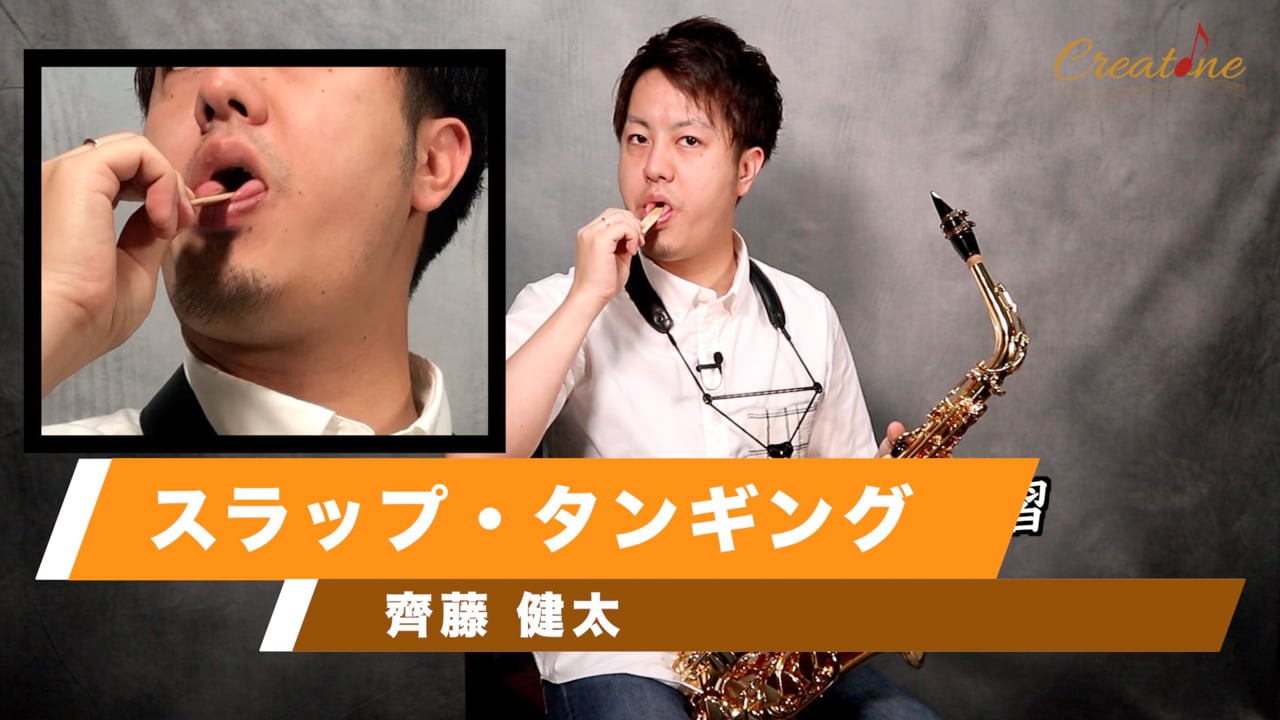
Saxophone Slap Tonguing Mastery Guide: Tips for This Essential Extended Technique
Slap tonguing is an essential technique in contemporary saxophone music and extended playing. This guide walks you step by step through mastering this challenging skill, from basic suction exercises to open slap.

Horn Orchestral Excerpts (Brahms Symphony No. 2, 1st Movement): Exaggerate the Score to Show Beat and Phrasing
The horn solo in Brahms's Symphony No. 2, 1st movement is long and serves as a critical audition excerpt. By exaggerating what is written in the score and shaping phrases to make the beat visible, you project the impression of deep musical understanding. This article outlines how to enter softly to manage risk, and how to create musical impact through crescendo and wave-like momentum.
![[Trumpet] Achieving Even Double and Triple Tonguing: Checkpoints to Eliminate Tonal Unevenness](https://i.vimeocdn.com/video/1845782087-f2058f7d7c804eacbbb5ae418f4b1bea8af99078b8499d9e31f5c78d3828be22-d_1280x720?&r=pad®ion=us)
[Trumpet] Achieving Even Double and Triple Tonguing: Checkpoints to Eliminate Tonal Unevenness
In trumpet double tonguing and triple tonguing, tonal unevenness is a major challenge beyond just speed. The "ka" syllable in "ta-ka-ta-ka" tends to be weaker, making it difficult to achieve an even sound. This article provides specific checkpoints for making double and triple tonguing uniform, along with practical methods including air speed control and alternating exercises.
![[Tuba] From Concept to Physical Awareness in Fundamental Practice: A Practical Routine to Prevent Boredom and Refine Breath and Articulation](https://i.vimeocdn.com/video/1845773601-e6750576b0613a394e017ee053480825d460e31f8ae763f4021c6fa409d3df04-d_1280x720?&r=pad®ion=us)
[Tuba] From Concept to Physical Awareness in Fundamental Practice: A Practical Routine to Prevent Boredom and Refine Breath and Articulation
In tuba performance, fundamental practice is an essential element of your daily routine. By understanding the concept of practice methods that provide continuous stimulation while preventing boredom, and by physically experiencing breath and articulation, you can achieve a stable tone quality. This article explains how to approach fundamental practice like strength training, the importance of producing sound with breath alone without relying on tonguing, and practical methods from non-tonguing articulation exercises to pitch verification.

The Key to Percussion Mastery! The Art of Bounce for Smooth High-Volume Rolls
Rolls are an essential technique in percussion performance. This lesson provides a detailed guide on bounce techniques for connecting loud rolls smoothly, the mindset for achieving uniform note quality, and proper stick handling. Learn to produce a rich, resonant sound without relying on brute force.

Trombone Lip Slur Fundamentals: Understanding the Mechanics for Smooth Register Transitions
Lip slurs are essential for developing flexibility in trombone playing. The core of this technique—changing notes without moving the slide—lies in varying the speed of your airstream. Learn the correct mechanics, master the fundamentals for moving freely between registers without relying on tension, and discover detailed guidance on how to use your body effectively.
![[Saxophone] The Art of Overtone Practice and Shaping Your "Oral Cavity" for a Rich Sound](https://i.vimeocdn.com/video/1845666653-cf4ef33e187f8a2098bf5a339ac327b56b3de6d8a8c1fe81ac9602e5f4db7cce-d_1280x720?&r=pad®ion=us)
[Saxophone] The Art of Overtone Practice and Shaping Your "Oral Cavity" for a Rich Sound
What gives a saxophone its depth of tone is not just the embouchure, but the volume of space inside your mouth. Learn the throat techniques and overtone control methods that directly lead to mastering altissimo.
![[Saxophone] Vibrato Practice Methods: Practical Steps to Master Control](https://i.vimeocdn.com/video/1845680215-617b93205fffe4a6cfe374fa4ac536b19467733d02ac6b3acbf60738e24c2ee1-d_1280x720?&r=pad®ion=us)
[Saxophone] Vibrato Practice Methods: Practical Steps to Master Control
Controlling the depth and consistency of vibrato waves is essential for saxophone players. This article explains how to master expressive vibrato through number control practice (3, 4, 5) with a metronome set to 60 BPM, and practical application in pieces (stop-and-apply exercises).
![[Trumpet] Instrument Maintenance and Practice Scheduling: A Practical Approach to Efficient Improvement](https://i.vimeocdn.com/video/1845302531-5f1430f2e14ef3a4a6cb39ada01a202a16ea69e66be32927570ee3fcc574d4ff-d_1280x720?&r=pad®ion=us)
[Trumpet] Instrument Maintenance and Practice Scheduling: A Practical Approach to Efficient Improvement
In trumpet playing, instrument maintenance and practice scheduling are essential elements for efficient improvement. By performing regular maintenance (cleaning the bore every 3-4 months and washing the mouthpiece daily), you can keep your instrument in optimal condition, and by creating a practice plan, you can systematically work through fundamentals, etudes, and repertoire. This article provides a practical guide to specific maintenance methods and how to build a weekly practice schedule.